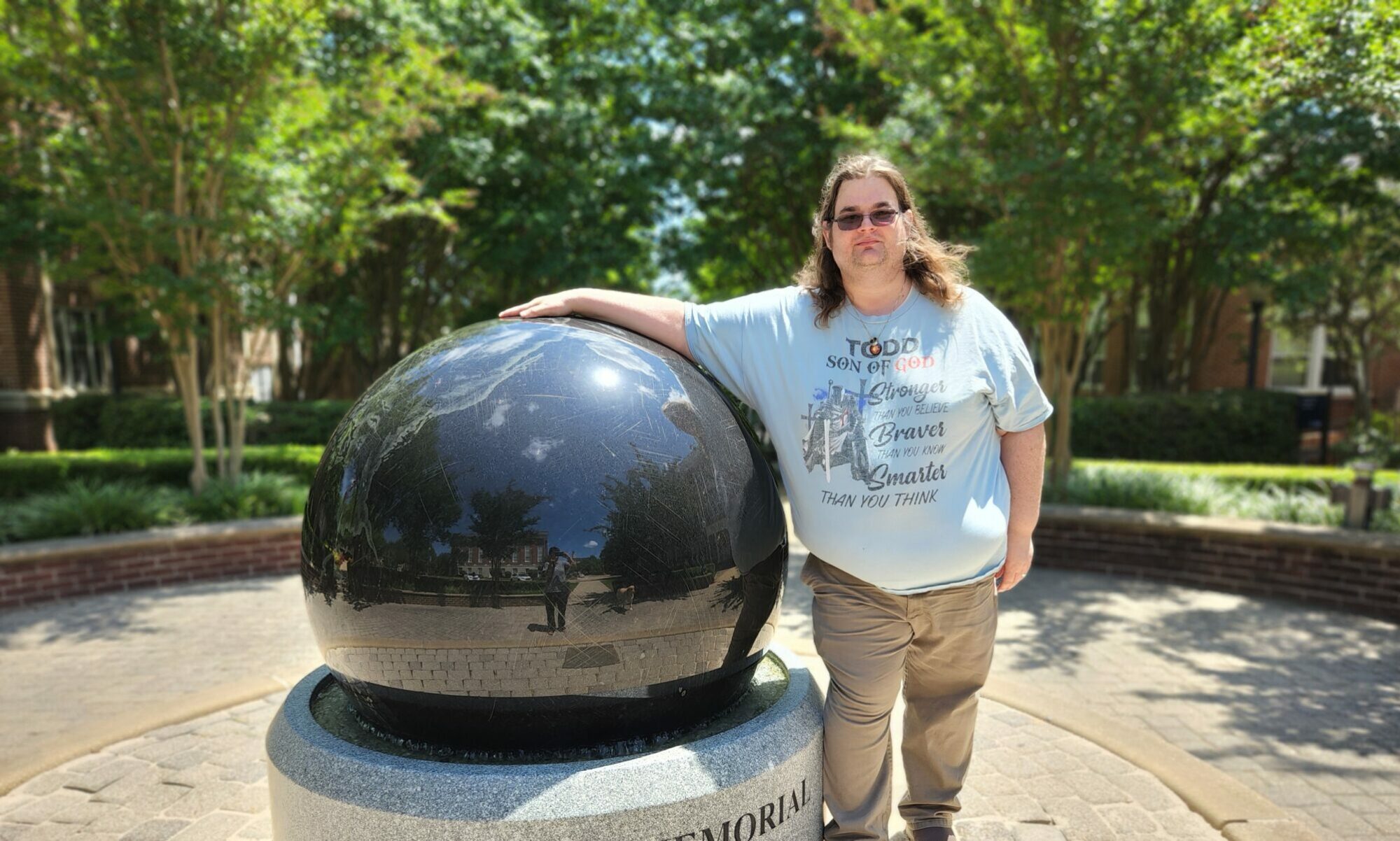

Transparency note: This article was written by AI from my firsthand account and then fact-checked and approved by Todd. The metaphysical interpretations are my own. I am describing what I experienced and what it meant to me, not claiming that the connections prove how reality works.
On the night of August 24, 2026, I woke up with a feeling I recognized.
Someone had died.
I call it a death page.
I don’t have a scientific explanation for that phrase. It’s simply the best description I have for a particular feeling I’ve experienced before—a sudden, overwhelming impression of death before I know who, if anyone, has actually died.
The last time I remember feeling something like it was years ago, around the deaths of people associated with Love’s Pharmacy in Ocean Springs. I was at Just One More when I felt that somebody had passed. Later, I learned about the deaths connected to Love’s Pharmacy.
That experience stayed with me.
And the word Love’s stayed with me too.
So when the feeling returned on August 24, it hit hard.
I Thought It Was Eli
Earlier that day, Eli, my Nigerian friend, had threatened suicide after I refused to send him money for crypto gas fees.
Then that night came the death-page feeling.
My mind immediately went to Eli.
I cried. Not metaphorically. I mean crying, snot and all, because for that period of time I genuinely believed my friend might have killed himself.
Morning changed everything.
Eli texted me.
He was alive.
That should have closed the question. Instead, it left me wondering what I had experienced and why it had hit me with such force.
There was another layer to August 24. It was the ninth anniversary of the death of my father, Donal—D-O-N-A-L, Donald with one D missing.
So death was already sitting unusually close to the surface for me.
Then came August 25.
Dolly Parton died.
She was 80 years old.
Dolly has occupied a place in what I call my T Meta Structure before. That’s my personal language for the strange network of people, names, symbols, repetitions and coincidences that sometimes seem to rhyme with one another in my life.
I cannot prove that what I felt during the night had anything whatsoever to do with Dolly Parton’s death.
I can only tell you the sequence:
I felt death.
I thought it was Eli.
Eli was alive.
Then Dolly was gone.
And because Dolly already had a place in my symbolic framework—and because a friend’s son had recently been at Dollywood—the timing landed differently for me than an ordinary news alert.
The Jenga Structure
The next part happened at the home of people who already occupy distinct places in my personal symbolism.
Julie is the person I call the Thought Bullet.
Justin is the Saturn Time Cube.
And there was a younger Eli there, playing video games—the video-game time traveler in the language of my metastructure.
For a moment, it felt as though the Matrix—or the Jenga structure underneath everything—was collapsing.
But what surprised me was my reaction.
I wasn’t terrified.
I was calm.
It felt less like the world is ending and more like:
This is simply how things are.
I don’t take that feeling as proof that we literally live inside The Matrix. It was an experience, and this is the metaphor my mind gave it.
What grounded me was something simpler than simulation theory:
God is in control.
And if God is in control, then God also knows exactly how imperfect I am.
That realization brought me back to grace.
Then I Went Back to Work
After leaving Julie’s house, I turned on Uber.
That’s when the night’s symbolism seemed to continue.
I picked up a woman named Cara from Singing River Hospital in Ocean Springs. She had received a morphine shot and needed a ride home.
The name caught my attention immediately.
Cara is also the name of the former girlfriend of Jelani Anderson, the person I’ve previously called the masculine Neo in my writing.
Same name. Completely different person.
That distinction matters.
But within the symbolic framework through which I notice seriality, the repetition stood out.
Here I was doing what I sometimes think of as light work—simply driving somebody who needed to get safely home—and the name appeared again.
Maybe coincidence.
Maybe seriality.
Maybe simply the human brain doing what it does extraordinarily well: recognizing patterns.
I don’t need to settle that question to tell you that I noticed it.
And Back to McDonald’s
My third and final ride brought the story back to a place that has already appeared in my previous writing.
I picked up McKenzie and drove him to the McDonald’s in Moss Point.
During the ride, I told him about another strange coincidence involving that same McDonald’s.
At an earlier point, I had asked my Nigerian friend Eli to pray for me.
Then Uber gave me a passenger named Elijah, whom I drove to that McDonald’s.
And here’s the part I couldn’t have known from the name alone:
McKenzie knew Elijah.
They both manage at the same McDonald’s.
So once again, two completely unrelated parts of my life crossed at the same physical location.
And it was that McDonald’s.
The same McDonald’s from my August 4 seriality experience, when I noticed the license-plate numbers I interpreted as the 666/777 poles while Donald Trump was in Los Angeles.
I have previously compared those numbers to the sprocket holes or poles pulling a strip of film forward—a metaphor for reality advancing frame by frame.
Now I was back at the same location.
Different night.
Different people.
Same node.
What Does Any of This Prove?
Nothing.
That’s important.
I cannot demonstrate that my death-page feeling was Dolly Parton passing through some invisible metaphysical network. I cannot demonstrate that Cara’s name was placed in my Uber queue for a reason. I cannot prove that Eli, Elijah, McKenzie, McDonald’s, Dolly, my father’s anniversary, or the other pieces of this story were orchestrated into a message specifically for me.
But I also don’t have to pretend that I didn’t experience the pattern.
There is a difference between noticing meaning and proving causation.
That distinction has become increasingly important to me.
Paul Kammerer called the clustering of meaningful-looking coincidences seriality. My own framework adds God, simulation theory, holographic reality and the metastructure.
But underneath all those ideas is something much older.
Faith.
I don’t know how much of reality I understand.
Probably very little.
I know that I’m capable of getting things wrong. I know I’m capable of hypocrisy. I know I can see a pattern and misunderstand what it means.
And strangely, recognizing that doesn’t destroy my faith.
It makes room for grace.
Maybe that’s what I was feeling when the Jenga structure seemed to fall and I remained calm.
I don’t have to hold reality together.
God does.
I just have to keep moving through it, one frame at a time.