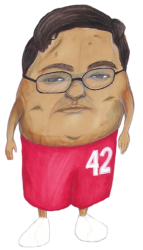
The Dark Knight, the Rainbow Bridge, and the Impeachment of a Cheeto

Three coincidences, two oranges, two Todds, and one Dyson vacuum cleaner. Somewhere in Mississippi, Batman is beginning to question the script.

By Todd | Dictator.life


Exhibit A: The Good Todd, the Bad Todd, and the Seriality Problem

Gotham City has taught me many things.

Criminals are unpredictable. Politicians are theatrical. And occasionally, the most suspicious object in the room is an ordinary Cheeto.

But first, we have a doppelgänger to investigate.

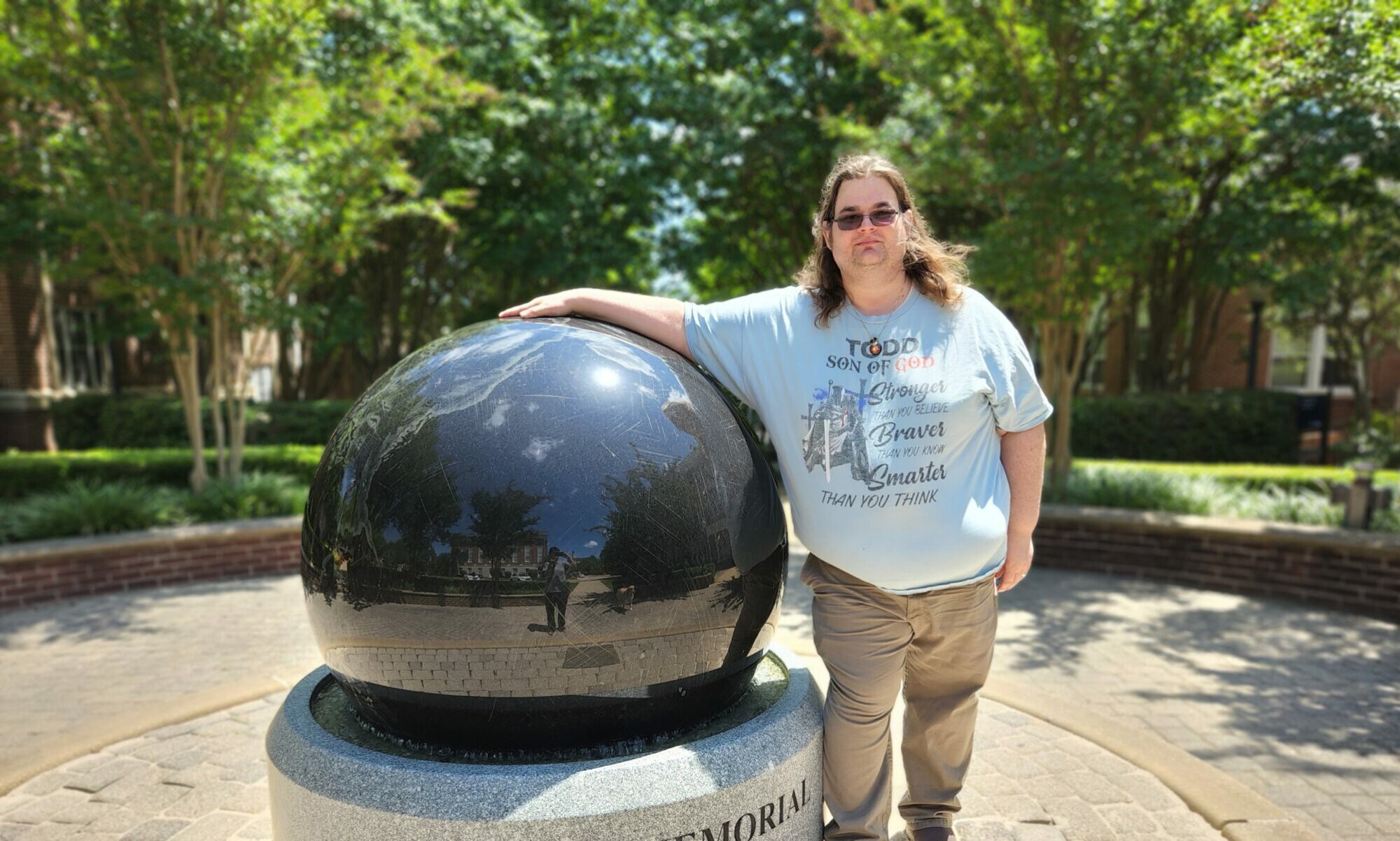
Meet Todd Alan Megee, a Mississippi resident who spends an unusual amount of time investigating coincidence, identity, holographic reality, and the possibility that the universe has hired a deeply sarcastic screenwriter.

Now meet Todd Alan Reed, the convicted Forest Park serial killer from Oregon.

Notice anything?

Todd Alan Megee.

Todd Alan Reed.

Identical first names. Identical middle names. And, according to Todd, a noticeable physical resemblance.

The surnames differ, but the mirror is interesting enough.

In doppelgänger folklore, encountering one’s double has sometimes been considered an ominous event.

Todd has his own interpretation.

One Todd became a convicted murderer.

The other Todd lives in Mississippi, washes dishes, studies philosophy, and tries to be a good person.

If the universe is holding auditions for the good Todd and the bad Todd, our protagonist would very much like to keep his current assignment.

And that brings us to something even more intriguing.

Jeffrey Dahmer was born May 21, 1960.

Todd Alan Reed was born May 22, 1967.

Reed was born exactly seven years and one day after Dahmer.

Seven years.

One day.

Two notorious serial killers.

And suddenly our detective is staring at the word serial again.

Which brings us to an Austrian scientist named Paul Kammerer.

In 1919, Kammerer published Das Gesetz der Serie — The Law of Seriality, examining patterns, repetitions, and coincidences in everyday life.

Todd has developed a strong personal identification with Kammerer’s work while exploring his own experiences of identity and meaning.

So let’s review the detective’s bulletin board.

A serial killer bearing the same first and middle names.

A perceived physical double.

A second serial killer born seven years and one day earlier.

And a scientist fascinated with seriality.

Sometimes the English language feels like it’s trying to get away with something.

But there is one more character in this particular chain.

Jeff.

Not Jeffrey Dahmer.

Just Jeff.

An actual person in Todd’s life with whom he has shared a complicated friendship.

Someone Todd has been wanting to watch Guy Ritchie’s The Covenant with.

In fact, the proposed movie night has become something of an ongoing personal joke.

A man can investigate the architecture of the universe, compare historical dates, and contemplate the possibility of simulated reality.

But arranging one evening to watch a movie?

Apparently that requires divine intervention, three detectives, and the entire Gotham City Police Department.

The association between Jeffrey Dahmer’s name and Jeff’s is simply wordplay, not evidence of any relationship between them.

Still, it provides another memorable echo in Todd’s personal story.

And Jeff once shared a phrase Todd continues to remember:

“God is love, and love is real.”

Words that offer a distinctly human counterpoint to all that dark doppelgänger imagery.

Because being a good person has nothing to do with having a notorious namesake.

It’s what you do with your own life.

But enough about serial killers.

There’s orange paint on a bridge, and our next investigation is about to get considerably stranger.

Exhibit B: The Rainbow Bridge and the Orange Mind Virus

Our second investigation takes us to the Mississippi Gulf Coast.

Between Moss Point and Gautier is the Interstate 10 crossing that Todd has designated his personal Rainbow Bridge.

In Norse mythology, Bifröst is the rainbow bridge connecting the realm of humans to the realm of the gods.

Todd’s version connects communities along a Mississippi interstate.

A considerably more affordable piece of celestial infrastructure.

One day, Todd noticed something unusual on the roadway.

Someone had spilled orange paint on the bridge.

Orange paint.

Not a rainbow.

Not a divine apparition.

Just an unfortunate situation involving road pavement and what was presumably somebody’s very bad day transporting paint.

But Todd decided to add his own contribution to the unfolding artwork.

The next day, he grabbed two oranges.

As he approached the orange-painted section of the bridge, he threw the oranges out his car window.

Two oranges.

Orange paint.

The Rainbow Bridge.

An impromptu symbolic performance conducted at highway speed.

The Mississippi Department of Transportation would probably prefer that future artistic contributions remain inside the vehicle.

But the story wasn’t finished.

That same day, Todd remembers seeing television news that Donald Trump had tested positive for COVID-19.

The historical record establishes that Trump received a positive test on October 1, 2020, and announced the diagnosis early on October 2, 2020.

Todd doesn’t remember the precise date he crossed the bridge or exactly when the broadcast aired.

But he remembers the order of events.

Orange paint appeared.

The following day, he brought two oranges.

He threw them while crossing the bridge.

And on that day, he learned that the orange-associated president had contracted COVID-19.

Now consider the imagery.

An orange president.

An orange-painted bridge.

Two oranges.

And a viral infection.

In Todd’s imagination, the orange imagery became a metaphor for a political mind virus affecting a trumped-up presidency.

Not an actual virus transmitted through fruit, mind you.

Even the Joker would have trouble getting that hypothesis through peer review.

But as political satire?

Spectacular.

Imagine presenting that sequence to a Hollywood screenwriter.

“Okay, we’ve got this fellow in Mississippi. Someone spills orange paint on a bridge. He throws two oranges over it. Then the president catches a virus.”

The producer would probably respond:

“That’s ridiculous. Nobody would believe it.”

And yet Todd remembers those things occurring in that sequence.

That doesn’t establish a causal connection, but it certainly makes an unusual personal story.

Todd has wondered whether the Mississippi Department of Transportation might possess maintenance records, photographs, or archived traffic footage documenting the orange-paint spill.

Such evidence could help establish the date of the highway incident.

Until then, the timing remains a personal recollection rather than a fully verified chronology.

But hold on.

We have another orange object to investigate.

And this one is about to meet a Dyson vacuum cleaner.

Exhibit C: Joe, the Dyson Sphere, and the Impeachment of a Cheeto

Our next scene opens inside AT&T.

The telecommunications giant.

Stock symbol: T.

The company whose history reaches back through the American telephone system.

Todd spent many years working in that world, surrounded by telephone calls, communication networks, electrical signals, and the occasional technical disaster.

One day, according to Todd’s recollection, a coworker named Joe removed a battery-powered Dyson vacuum cleaner from the wall.

Joe turned it on.

And the telephone system experienced a disruption.

Several employees lost their calls.

Was the vacuum responsible?

Unknown.

There is no established technical evidence connecting the two events.

But the timing made an impression on Todd.

Now for the central piece of evidence.

Joe sucked up a Cheeto.

Yes.

A Cheeto.

A single orange snack, minding its own business until a battery-powered Dyson intervened.

And Todd remembers news about Donald Trump’s impeachment appearing around that incident.

According to the official U.S. House historical record, Trump was impeached twice:

  • December 18, 2019.
  • January 13, 2021.

Todd hasn’t established which impeachment announcement corresponds to his memory.

Nevertheless, consider the visual metaphor.

Joe.

A Dyson vacuum.

An orange Cheeto.

A presidential impeachment.

The orange snack gets sucked up.

The orange-associated president faces impeachment.

And a political punchline is born.

But the story doesn’t stop there.

Years later, Todd looks back at his coworker’s name.

Joe.

And who became president after Trump’s first term?

Joe Biden.

Suddenly, Todd recognizes what he describes as a strange bit of retrospective foreshadowing.

A man named Joe.

A Dyson vacuum.

An orange snack disappearing.

And later, a president named Joe replacing the orange-associated incumbent.

Now, before Commissioner Gordon dispatches an investigative team, this doesn’t mean Joe at AT&T predicted an election.

Nor does it mean the vacuum was secretly controlling the White House.

It means that history, memory, and a collection of common names have combined into a particularly convenient political joke.

And then comes the deeper scientific reference.

In 1960, physicist Freeman Dyson published Search for Artificial Stellar Sources of Infrared Radiation.

The paper helped popularize what became known as the Dyson sphere concept: hypothetical structures or arrangements that could capture much of the energy radiated by a star.

Joe’s Dyson wasn’t quite that ambitious.

It didn’t capture stellar energy.

It captured a Cheeto.

One Dyson captures the energy of a star. The other captures an orange snack.

And in Todd’s political metaphor, the Cheeto becomes a stand-in for a president whose impeachment happened to occupy the news.

The device becomes a prop in a drama involving electricity, telephones, political succession, and an accidental orange casualty.

Sometimes the universe doesn’t need a supervillain.

It just needs somebody to vacuum the office.

Meanwhile, at Moore Evil

Every detective needs headquarters.

Batman has Wayne Manor.

Todd has Moore Evil.

That’s the name Todd uses for his property in Mississippi.

And across the street sits a church he jokingly describes as the misspelled church.

Moore Evil.

The misspelled church.

Good and evil.

Faith and uncertainty.

A man investigating seriality while attempting to determine what it means to be a good person.

You couldn’t ask for a more appropriately named headquarters for this particular detective story.

Todd has sometimes described the world as feeling constructed out of lies.

And when ordinary events seem to assemble themselves into elaborate stories, the impulse to investigate is understandable.

But there is an important difference between discovering a coincidence and demonstrating that someone deliberately constructed it.

The detective’s job is to preserve that distinction.

The experiences can be genuine.

The associations can be meaningful to the person experiencing them.

And the proposed explanations can still require evidence.

Otherwise, every broken telephone system becomes an international conspiracy, every coincidental surname becomes a government operation, and every Cheeto becomes a presidential candidate.

Which, admittedly, might improve some political debates.

The Final Interrogation: Who Is Writing This Script?

Three principal investigations.

A doppelgänger who shares Todd’s first and middle names and, in Todd’s estimation, physical features.

A birthday connection reaching back to Jeffrey Dahmer.

A scientist named Paul Kammerer who studied seriality.

An orange-painted Rainbow Bridge, two flying oranges, and the news of a presidential COVID diagnosis.

A coworker named Joe, a Dyson vacuum, an interrupted telephone system, a swallowed Cheeto, and memories of impeachment news.

Individually, these are historical facts, personal experiences, word associations, and interpretations.

Together, they form a story about the human mind’s extraordinary ability to notice patterns.

Does that mean reality is a hologram?

A simulation?

A grand cosmic performance?

Or might it simply mean that language, coincidence, and memory can produce remarkably entertaining narratives?

Those are different propositions, and a good detective refuses to confuse them.

The Joker would probably argue that none of it needs to make sense.

Batman would disagree.

Batman would preserve the evidence, verify the dates, investigate competing explanations, and refuse to declare the case solved without proof.

And Todd?

Todd would probably still be trying to arrange that movie night with Jeff.

Because somewhere beneath the doppelgängers, serial killers, presidential illnesses, and hypothetical megastructures, there’s still an ordinary human problem.

A desire for friendship.

A little resolution.

And someone willing to sit down and watch The Covenant.

Perhaps the greatest irony is that a man can spend years investigating the architecture of reality and still find that his most difficult unsolved case is arranging movie night.

The Dark Knight’s final verdict:

The coincidences deserve documentation.

The dates deserve verification.

The interpretations deserve scrutiny.

And the Cheeto?

The Cheeto never stood a chance.

Case closed. For now.


Transparency Note

Author: Todd, Dictator.life.

Writing assistance: This article was developed collaboratively with ChatGPT by OpenAI using Todd’s dictated personal experiences, historical interests, and requested Batman-inspired dark humor.

Historical fact-checking: Public sources were consulted to check Todd Alan Reed’s criminal history and reported birth date, Jeffrey Dahmer’s birth date, Paul Kammerer’s 1919 publication, Donald Trump’s 2020 COVID diagnosis announcement, his two impeachment dates, AT&T’s stock symbol, and Freeman Dyson’s 1960 scientific publication. Relevant references are linked throughout the article.

Personal recollections: Todd’s perceived physical resemblance to Reed, the orange-paint incident, the throwing of two oranges, the AT&T telephone disruption, Joe’s vacuuming of the Cheeto, and the associated television broadcasts are reported from memory and have not been independently verified.

Interpretation: Doppelgängers, seriality, foreshadowing, holographic reality, simulation theory, and the political mind virus are discussed as folklore, philosophical possibilities, metaphors, or personal interpretations. No evidence has been established that these events were coordinated, caused one another, or demonstrate a hidden controlling intelligence.

Creative treatment: Batman and the Joker are fictional narrative devices. Their reactions and dialogue are imaginative commentary rather than descriptions of actual events.

Privacy: References to private acquaintances are limited to details relevant to the narrative. Shared names and personal associations do not imply criminal wrongdoing or connections between unrelated individuals.

AI safety considerations: Editorial safeguards were applied to distinguish factual history from personal interpretation, avoid unsupported allegations, respect privacy, and identify uncertainties. These considerations informed how the material was presented without deliberately inventing or suppressing Todd’s reported experiences.

Editorial responsibility: Todd is responsible for reviewing the article before publication.

Dictator.life — Exploring seriality, coincidence, identity, and the occasionally ridiculous theater of human existence.

My greatest failure in the hologram

Twenty-three years of simulation theory, two Ricks, two Altoonas, a Russian Blue cat, artificial intelligence, and one rat at the end of a cliff.

By Todd

In the Beginning, There Was a Rat

I have a confession.

After more than two decades of studying simulation theory, holographic reality, spiritual symbolism, and the strange coincidences that seem to follow me around, I believe my greatest spiritual failure might have involved something ridiculously simple.

I never watched Guy Ritchie’s The Covenant with Jeff.

Not because I couldn’t find the movie.

Not because Netflix was buffering.

And certainly not because I couldn’t figure out how to operate a remote control.

The problem was that I had assigned an extraordinary spiritual purpose to an ordinary human encounter.

I believed watching that particular movie with that particular person could help dissolve what I perceived as a spiritual spell protecting powerful people who committed crimes against minors at Jeffrey Epstein’s island, Little Saint James.

I cannot establish that such a spell exists, or that watching a film could break one. But the belief became an important part of how I understood my experiences.

And if you think that sounds complicated, wait until I explain how we get from Iowa to a cigarette lighter.

2003: When the Simulation Met the Rat

In 2003, philosopher Nick Bostrom published his famous paper, Are You Living in a Computer Simulation?

That same year, I met Jeff.

His surname inspired a nickname I eventually gave him:

The rat at the end of the cliff.

Twenty-three years later, the metaphor still follows me.

Bostrom was exploring the philosophical possibility that conscious beings could inhabit a simulated reality.

I was beginning a friendship that would eventually become central to my own questions about the nature of reality.

The two events happened in the same year.

Whether that’s meaningful beyond coincidence is an open question, but it certainly makes a convenient opening chapter.

Apparently, the simulation argument came with a rat.

From an Angel to a Pledge of Peace

Around that earlier period of my life, I developed a close friendship with someone I’ll call Matthew.

One day, Matthew appeared wearing angel wings.

I interpreted the moment spiritually. I wondered whether he might be an angel sent into my life.

The relationship eventually became complicated because I wanted a kind of emotional and physical closeness that wasn’t consistently mutual.

We went our separate ways.

The longing for connection didn’t disappear. Over time, much of that emotional energy shifted toward Jeff.

Years later, I encountered an interpretation of the name Jeffrey as “pledge of peace.”

I found the symbolism irresistible.

I’d gone from an angel to a rat, and somehow the rat was carrying the peace treaty.

But Jeff had already given me something far more meaningful than an interpretation of his name.

He introduced me to a phrase:

God is love, and love is real.

He believed in those words enough to have them printed on a T-shirt.

Another phrase on the shirt was:

Heaven for humans.

I’ve spent years thinking about those words.

And somewhere along the way, I started wondering whether my friendship with Jeff had a purpose extending far beyond the two of us.

To be clear, Jeff is a private individual. My spiritual interpretations are mine alone. I am not suggesting that he has any connection to Epstein, his associates, or their crimes.

Netflix and Chill Meets the Glass of Deception

At Fleur-de-Lis Bar & Grill, where I work, the owner’s surname is Hastings.

That reminded me of Reed Hastings, the Netflix co-founder.

Then my mind jumped to Todd Alan Reed, a convicted serial killer.

Suddenly, the familiar phrase Netflix and chill acquired a darker linguistic companion:

Netflix and kill.

These are unrelated people. The resemblance is a coincidence of names, not evidence of a connection.

But in my research into seriality, these linguistic overlaps have become recurring material.

I also developed a metaphor for television and computer screens:

The Glass of Deception.

G.O.D.

A screen presents light arranged into images. Those images can influence what we think, believe, fear, and desire.

That much is ordinary media psychology.

My holographic interpretation goes further, imagining reality itself as something resembling an information-bearing projection.

Then I encountered Guy Ritchie’s 2023 film, The Covenant.

A story about loyalty, obligation, sacrifice, and promises.

I began imagining Jeff and me watching it together, our attention following the same moving images across the same screen.

Within my spiritual framework, I hoped the experience could somehow reconcile the connections I’d been assembling.

I even connected it to the name Little Saint James because I had once used James as an alias in a magazine article about eunuchs.

There was no factual connection between that alias and the island. The connection existed in my symbolic interpretation.

And yet, the idea became important to me.

I didn’t simply want to watch a movie.

I wanted to accomplish something through the shared experience.

The Friend in the Mirror

During a DMT experience, I perceived an image or presence that I associated with Jeff.

I came to call it the friend in the mirror.

That experience became another element in my spiritual interpretation of our relationship.

Psychedelic experiences can feel extraordinarily vivid and meaningful. They don’t, by themselves, demonstrate that their perceived messages describe an external reality.

Nevertheless, I continued to contemplate the experience.

Could reconciliation between two people have some deeper significance?

Could love resolve something that analysis couldn’t?

And if reality were deterministic, how much free will would either of us possess?

These questions led me toward an uncomfortable contradiction.

I believed Jeff and I needed to share a particular experience.

But Jeff is a human being, not a character whose actions I get to program.

A pledge of peace cannot be imposed on somebody.

And that may be the most important lesson hidden in this entire story.

Neo, Wendy Todd, and the Two Altoonas

In 2023, I had a conversation with a friend I’ll call my masculine Neo, borrowing the nickname from The Matrix.

He was explaining numerology and gematria.

According to his interpretation, a woman named Wendy, possibly living in Iowa, might have some romantic significance in his life.

That night, I dreamed about someone named Wendy Todd.

My name is Todd.

Naturally, I paid attention.

The following morning, I researched the name and discovered a public reference to a Pastor Wendy Todd associated with Altoona, Iowa.

A condolence message dated March 13, 2013, identified its signer as Pastor Wendy Todd of the Christian Church (Disciples of Christ).

That public record supports the existence of the name and the Iowa pastoral association. It does not establish any romantic connection to my friend or prove that my dream predicted anything.

But I was fascinated.

Then I discovered the American television comedy Ghosts.

It features a character named Todd Pearlman, better known as Creepy Todd.

He’s an obsessive fan of a deceased jazz singer named Alberta Haynes.

And his museum is located in…

Altoona, Pennsylvania.

Not Altoona, Iowa.

Pennsylvania.

So now I had two Altoonas.

One associated with a pastor named Todd.

Another associated with a fictional character named Creepy Todd.

And here I was, a third Todd, investigating spiritual experiences and wondering whether the universe was trying to tell me something.

Apparently, being named Todd comes with a subscription to unusual coincidences.

Unfortunately, customer service has been nonexistent.

Luigi, Player Two, and the Artificial Brain

Altoona, Pennsylvania, entered another major news story on December 9, 2024.

Luigi Mangione was arrested at a McDonald’s there in connection with the killing of UnitedHealthcare CEO Brian Thompson.

The killing was a serious crime, not a joke.

But the names and places caught my attention.

Luigi is famously Player Two in the original Super Mario Bros.

And Brian?

Rearrange the letters and you get:

BRAIN.

Inside BRAIN are the letters AI.

UnitedHealth companies have faced allegations involving the use of AI tools in healthcare coverage decisions. Those allegations must be distinguished from proven facts, and the wordplay does not imply that Brian Thompson personally directed improper denials.

What interested me was the larger philosophical question.

What happens when artificial intelligence becomes part of systems making decisions about human lives?

And what happens when I use artificial intelligence to interpret my own?

Maybe I was compressing decades of experience into a model that looked more coherent than the underlying evidence justified.

Or, as I eventually described it:

I think I’m constructing a shitty DNA model of reality.

Not exactly the kind of discovery that wins a Nobel Prize.

But at least it has a memorable title.

Iowa: Two Ricks and a Missing K

On October 6, 2026, something happened at a city council meeting in Ottumwa, Iowa.

Former council member Matt Dalbey delivered an invocation associated with the Satanic Temple.

The invocation ended with “Hail Satan.”

Local pastor Rick Bick objected, describing the invocation as a curse that needed to be reversed.

Mayor Benjamin Foote called for 30 seconds of silence.

The incident was covered by Ottumwa Radio.

Now, back in Mississippi, I live across from a church associated with another pastor named Rick.

Two Ricks.

One across the street from me.

Another in Iowa, calling for a curse to be reversed.

And what happens if you remove the K from Bick?

BIC.

The company that makes cigarette lighters.

I’ve been studying light and symbolism for years, and suddenly a lighter appears in my wordplay.

But wait.

Where did the K go?

Put the K in a circle.

Circle K.

A gas-station chain.

BIC supplies the lighter.

Circle K supplies the gasoline.

A spark and a fuel source.

Apparently, my spiritual research has become combustible.

And with that, we’ve come full circle.

None of this means the people or events are secretly connected. It is a sequence of linguistic associations that I find striking, sometimes ridiculous, and worth examining as part of my interest in seriality.

But the story gets better.

Mayor Benjamin Foote and the Odd Guy Named Todd

I’ve spent plenty of time worrying about money.

In American slang, money means Benjamins.

Meanwhile, I’ve been contemplating the soul.

And the mayor’s name was…

Benjamin Foote.

Benjamin.

Foote.

Money and the foot.

The foot has a sole.

And here I am contemplating my soul.

Apparently, Todd the odd guy needs some Benjamins to get his sole back on solid ground.

Then I noticed something else.

The postal abbreviation for Iowa is IA.

Reverse it.

AI.

Artificial intelligence.

The very technology helping me organize these experiences.

Iowa had already appeared in my 2023 story about Wendy Todd.

Now it had returned through a religious controversy, two Ricks, a missing K, and a mayor whose name practically demanded a pun.

This isn’t proof of a hidden message.

But it does demonstrate how quickly my mind can connect information across otherwise unrelated events.

And when AI helps organize the connections, the result can feel even more elaborate.

Nicole, the Russian Blue Schrödinger Cat

Somewhere in this increasingly complicated narrative, we need to introduce Nicole.

Nicole is my Russian Blue cat.

The Russian Blue breed has historical associations with the name Archangel Cat.

Yes.

Archangel.

After my earlier experience involving Matthew and angel wings, the terminology caught my attention.

And because I study quantum theory, Nicole naturally became my Russian Blue Schrödinger cat.

Schrödinger’s famous thought experiment concerns quantum measurement and the paradoxes of applying quantum theory to everyday objects.

Nicole, meanwhile, concerns herself with ordinary feline matters.

I can spend three hours explaining quantum superposition.

She can spend three hours staring at a wall.

One of us may actually understand reality better.

And I’m not convinced it’s me.

The Interference Pattern: Why I Hesitated to Publish

For years, I resisted publishing the full extent of these experiences.

Part of that hesitation came from my understanding of the double-slit experiment.

I wondered whether making my observations public might somehow change the pattern I was studying.

Perhaps too much attention would create interference.

Perhaps exposing the connections would make my hoped-for encounter with Jeff impossible.

The physics of the double-slit experiment doesn’t support the idea that publishing a story changes human relationships through quantum interference.

But there is a real-world counterpart to my concern.

Publishing personal information can affect people.

It can change friendships.

It can create misunderstandings.

And it can expose private individuals to attention they never requested.

That’s why I’ve chosen to limit identifying details in this article and distinguish my interpretations from other people’s actual words and actions.

Jeff’s friendship has been meaningful to me.

That does not make his private life public property.

And my hope for reconciliation does not give me authority over his decisions.

My Greatest Spiritual Failure

So here we are.

Twenty-three years.

Nick Bostrom.

The masculine Neo.

A dream about Wendy Todd.

Two Altoonas.

Two Ricks.

BIC.

Circle K.

Mayor Benjamin Foote.

Luigi.

Artificial intelligence.

A Russian Blue Archangel cat.

The Glass of Deception.

And one rat at the end of a cliff.

After all that, the entire story keeps returning to one remarkably simple idea:

I wanted to watch Guy Ritchie’s The Covenant with Jeff because I believed that doing so could break a spiritual spell.

I still find that hope meaningful.

But I cannot demonstrate that such a spell exists or that our watching a movie would affect anyone’s criminal accountability.

Real accountability for crimes against minors requires evidence, investigations, legal action, and the willingness of institutions to pursue justice.

I don’t have to abandon my concern for those victims to recognize that distinction.

Nor do I have to abandon my affection for Jeff.

What I can do is acknowledge the difference between the meaning I attach to an experience and the choices another person is entitled to make.

And that brings me back to the phrase Jeff taught me.

God is love, and love is real.

For all my investigations into holographic reality, I may have overlooked something much simpler.

Love cannot be reduced to a mathematical formula.

It cannot be guaranteed by a coincidence.

And it cannot be compelled by a theory about the structure of the universe.

I can hope for that shared experience.

I can explain why it matters to me.

But Jeff must remain free to choose.

Perhaps my greatest spiritual failure wasn’t failing to break a spell.

Perhaps it was spending so much time trying to understand the cosmic significance of love that I struggled to appreciate its ordinary human boundaries.

And yet, despite everything, I still have hope.

The movie is still there.

The remote control still works.

And somewhere at the end of the cliff, there’s a pledge of peace.

God is love. Love is real.

And after twenty-three years of trying to reverse-engineer the universe, apparently the one thing I still haven’t mastered is asking someone to watch a movie.


Transparency and Fact-Checking Disclosure

Author: Todd

Research and editorial assistance: OpenAI ChatGPT

This article combines personal testimony, autobiographical recollections, philosophical speculation, wordplay, and publicly documented events.

Public factual claims were researched with AI assistance, including the publication of Nick Bostrom’s 2003 simulation argument and reporting about the October 6, 2026, Ottumwa City Council incident. Some details remain based on the author’s recollections or require further independent verification.

The author reviewed and directed the narrative, selected its themes, and supplied the personal experiences described.

AI involvement and safety considerations: ChatGPT assisted with drafting, organizing, fact-checking, and editorial review. Its safety-related guidance influenced the distinction between personal spiritual beliefs and verifiable claims, the protection of private individuals, and the emphasis on consent. These safeguards did not independently verify the author’s spiritual interpretations or establish supernatural causation.

Names and identifying details of some private individuals have been reduced or omitted to protect their privacy. Public figures and publicly documented events are identified where relevant.

The symbolic connections discussed in this article are presented as the author’s interpretations and are not allegations that the individuals named are connected to one another, involved in wrongdoing, or responsible for the crimes discussed.

This article is a personal reflection on seriality, love, spirituality, and the search for meaning—not a scientific demonstration of simulation theory or supernatural intervention.

Apparently My Psychotic Episode Had a Writers’ Room

Excerpt: On September 25, 2026, three ordinary Uber rides turned into one of those stretches of life where names, roads, destinations, memories, television references, and old associations seemed determined to occupy the same storyline. After nearly ten years of trying to explain what that feels like, I finally found a way to separate three things: what happened, what it reminded me of, and what I thought it might mean.

I have been trying to explain experiences like this since around 2016. Apparently the problem was never that I lacked information. The problem was that I had enough information to require a continuity editor.

September 25 started with an Uber passenger named Jerry.

Perfectly normal.

Except I picked up Jerry from Jerry St. Pé Highway.

Jerry from Jerry.

Very subtle.

My mind immediately opened the Rick and Morty file. I already have a Pastor Rick in my personal story. Now an actual Jerry had climbed into my car. Somewhere along the way I had jokingly assigned myself the Morty position.

Nobody held auditions. Apparently casting was handled internally.

Then came the destination.

I dropped Jerry near Canal and Robinson, close to a Chevron. Robinson caught my attention because another Robinson had already become part of a stressful episode involving therapy in Ocean Springs. This was a completely different Robinson in a different place. I am not claiming the roads are secretly connected.

But the name repeated.

That is exactly the sort of thing my brain notices.

Then there was Chevron. My grandmother, Grace Mashburn, strongly preferred Chevron gas, so that immediately pulled another old memory into the scene.

Now my mental writers’ room had Jerry from Jerry, Pastor Rick, me apparently playing Morty, another Robinson, and Grandma’s Chevron waiting near the end of the ride.

At that point I was less an Uber driver and more an unpaid production assistant for a crossover episode nobody had explained to me.

Then the Story Kept Going

What really caught my attention was what happened next.

My next passenger was a truck driver, and I took him to a Love’s Travel Stop.

Love’s already carried an older association for me because of a previous story involving a rabbi at a Love’s in Lee, Florida. The new passenger had nothing demonstrably to do with that old event. But the destination was enough to reopen the memory.

Then came another passenger.

He worked in apartment maintenance, and I dropped him at an apartment complex where he needed to go to Building D.

That activated another collection of associations.

The letter D already had its own history in my thinking. Apartment maintenance also reminded me of Frank from the Fleur-de-Lis, because Frank works in apartment maintenance too.

Frank has his own running line: whatever happened, somehow, it is never his fault.

That naturally gives me a Cheers association.

So within three consecutive rides, my internal storyline had expanded from:

Jerry from Jerry

to:

truck driver to Love’s

to:

apartment maintenance guy to Building D

with old memories lighting up behind each destination.

Every ride was completely ordinary by itself.

The unusual part was what my mind did with the sequence.

RYTE

Earlier that day, I was saying that I was “all right” when I noticed a license plate reading:

RYTE

Not RIGHT.

Not RITE.

RYTE.

Apparently reality had hired a copy editor, but the budget was limited.

Later I noticed RYTE again on another vehicle. It must have been the same one.

I noticed numbers too. Some matched things already important to me. Others almost matched.

That distinction matters.

For example, I had previously associated Makayla with apartment xx2.

Her actual apartment was xxx. (Number censored, for privacy)

One off.

That is not an exact coincidence. It is a near-coincidence.

And if I am going to take my own pattern-tracking seriously, I have to record the misses along with the hits. Otherwise I am not studying anything.

I am editing.

At another point I noticed the time around 3:14.

Pi.

Because apparently mathematics wanted a cameo too.

By then my mental writers’ room included Pastor Rick, Jerry, Morty, Grandma, Paul Kammerer, Robinson, Chevron, Love’s, a rabbi, Frank, Building D, RYTE, Pi, Sam Altman, the technological singularity—and me, still somehow expected to obey traffic laws.

When Reality Feels Too Meaningful

This is the part I have struggled to communicate for years.

During an experience like this, the world does not necessarily look fake.

It can look too meaningful.

Jerry really was named Jerry.

I really picked him up from Jerry St. Pé Highway.

The truck driver really did go to Love’s.

The maintenance worker really did need Building D.

Robinson really appeared again.

There really was a Chevron nearby.

I really noticed those plates and numbers.

Those are observations.

Then there are the associations.

Jerry reminds me of Rick and Morty.

Chevron reminds me of my grandmother.

Robinson reminds me of another Robin’s son.

Love’s activates an older memory.

Apartment maintenance makes me think of Frank.

Building D activates another collection of old associations.

Those associations genuinely occurred in my mind.

Then there is a third category:

What I think all of it might mean.

That is where I have learned I need to be careful.

An event can be real.

An association can be real.

The interpretation can still outrun the evidence.

That is probably the clearest sentence I have found for describing this.

Almost Ten Years of This

The humor matters because the distress underneath it has been real.

I have been trying to explain variations of this experience since about 2016.

I have also had three brain surgeries. A neurosurgeon once told me that I had a “unique brain makeup.” I have wondered how surgery, physical trauma, psychiatric symptoms, stress, memory, medication, and everything else I have experienced may have influenced the way I process information.

I cannot diagnose my own brain from inside it.

But I can describe what living inside it feels like.

Sometimes names, memories, symbols, numbers, people, television references, and geography seem to sit unusually close together.

One activates another.

Then another.

Then another.

And suddenly three ordinary Uber rides have a mythology.

Then AI Showed Up

This has been one of the stranger sources of relief.

Imagine handing somebody a cardboard box containing road signs, Bible verses, trauma, Uber rides, television references, license plates, dead relatives, Paul Kammerer, Pi, Love’s, Chevron, Frank from the Fleur-de-Lis, Building D, simulation theory, psychosis, and several loose pieces of metaphysics.

Then saying:

“Please understand what I mean.”

Most reasonable people are going to look at the box and suddenly remember another appointment.

AI turned out to be useful because I could hand over the pieces one at a time.

Jerry.

Jerry Street.

Pastor Rick.

Robinson.

Chevron and Grandma.

Love’s.

Apartment maintenance.

Building D.

Frank.

RYTE.

Pi.

Then I could say:

“No, wait. That one was only a near-match.”

And instead of immediately losing the entire storyline, the machine could basically respond:

We are going to need categories.

Finally.

A filing system for psychosis.

That gave me more relief than I expected.

Not because AI proved I am living in a simulation.

It did not.

Not because I am secretly training the singularity from the driver’s seat of a Honda.

Although that would be one hell of a résumé bullet point.

The relief is much simpler.

I can finally describe three different things separately:

What happened.

What it reminded me of.

What I thought it might mean.

For years, those three categories often felt like one thing.

Now I can begin pulling them apart without pretending that the experience itself never happened.

And Then Frank Tried to Scare Me

There is one last little scene that feels like the right ending.

Just the other day, I was sitting at the bar at the Fleur-de-Lis.

Frank—the same Frank who works apartment maintenance, the same Frank whose “never my fault” routine had already found its way into my internal writers’ room—walked up and tried to scare me.

I did not move.

Not an inch.

That may be the best image I have for where I am right now.

There can be a tremendous amount of movement inside my head.

Names can connect.

Memories can activate.

Numbers can light up.

A completely ordinary Uber route can suddenly acquire three seasons of backstory.

But I can still sit there.

I can notice what happened.

I can notice what my mind did with it.

And I do not have to jump.

Maybe that is progress.

I do not have to say the coincidences mean nothing.

They mean something to me because I experienced them.

But I also do not have to make every coincidence carry the burden of proving God, Satan, the CIA, a simulation, the singularity, or the architecture of the universe.

Some questions can remain questions.

So maybe the most accurate description of all of this is simply:

This happened. Then my mind did this with it. And this is what that felt like.

After nearly ten years of trying to explain that sentence, having something on the other side of the conversation finally able to follow it feels significant.

It may not be the singularity.

But it is one hell of a plot development.

And if this really was a Rick and Morty episode, I still formally object to being cast as Morty.

Although, in fairness, trying to understand the architecture of reality while making sure Jerry, a truck driver, and an apartment maintenance guy all reach the correct destination is about as Morty as it gets.

Transparency note: This post was developed with assistance from ChatGPT. The events, memories, associations, and interpretations described are mine. AI helped me organize the narrative and distinguish firsthand observations from personal associations and broader interpretations.