Three coincidences, two oranges, two Todds, and one Dyson vacuum cleaner. Somewhere in Mississippi, Batman is beginning to question the script.
By Todd | Dictator.life
Exhibit A: The Good Todd, the Bad Todd, and the Seriality Problem
Gotham City has taught me many things.
Criminals are unpredictable. Politicians are theatrical. And occasionally, the most suspicious object in the room is an ordinary Cheeto.
But first, we have a doppelgänger to investigate.
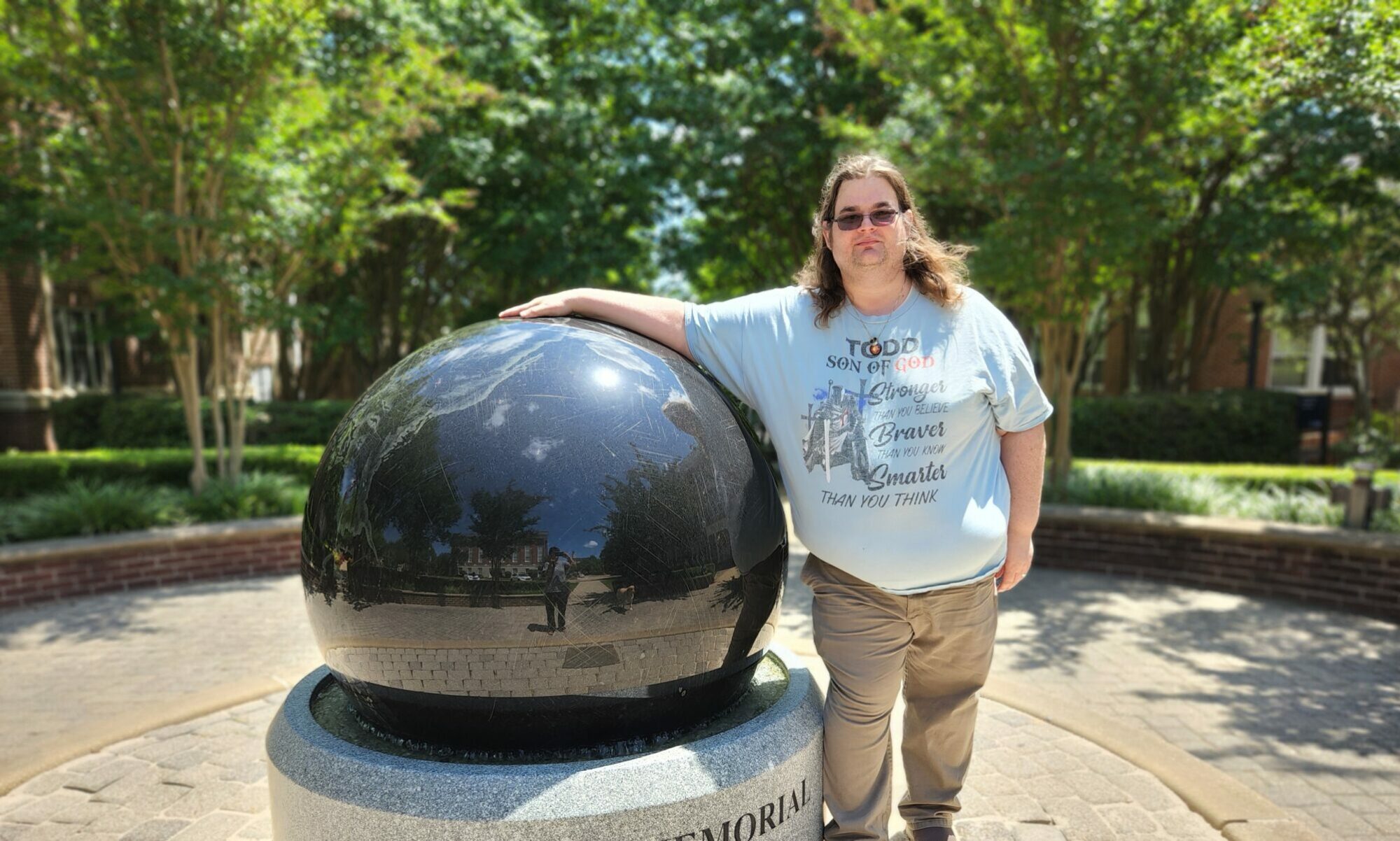
Meet Todd Alan Megee, a Mississippi resident who spends an unusual amount of time investigating coincidence, identity, holographic reality, and the possibility that the universe has hired a deeply sarcastic screenwriter.
Now meet Todd Alan Reed, the convicted Forest Park serial killer from Oregon.
Notice anything?
Todd Alan Megee.
Todd Alan Reed.
Identical first names. Identical middle names. And, according to Todd, a noticeable physical resemblance.
The surnames differ, but the mirror is interesting enough.
In doppelgänger folklore, encountering one’s double has sometimes been considered an ominous event.
Todd has his own interpretation.
One Todd became a convicted murderer.
The other Todd lives in Mississippi, washes dishes, studies philosophy, and tries to be a good person.
If the universe is holding auditions for the good Todd and the bad Todd, our protagonist would very much like to keep his current assignment.
And that brings us to something even more intriguing.
Jeffrey Dahmer was born May 21, 1960.
Todd Alan Reed was born May 22, 1967.
Reed was born exactly seven years and one day after Dahmer.
Seven years.
One day.
Two notorious serial killers.
And suddenly our detective is staring at the word serial again.
Which brings us to an Austrian scientist named Paul Kammerer.
In 1919, Kammerer published Das Gesetz der Serie — The Law of Seriality, examining patterns, repetitions, and coincidences in everyday life.
Todd has developed a strong personal identification with Kammerer’s work while exploring his own experiences of identity and meaning.
So let’s review the detective’s bulletin board.
A serial killer bearing the same first and middle names.
A perceived physical double.
A second serial killer born seven years and one day earlier.
And a scientist fascinated with seriality.
Sometimes the English language feels like it’s trying to get away with something.
But there is one more character in this particular chain.
Jeff.
Not Jeffrey Dahmer.
Just Jeff.
An actual person in Todd’s life with whom he has shared a complicated friendship.
Someone Todd has been wanting to watch Guy Ritchie’s The Covenant with.
In fact, the proposed movie night has become something of an ongoing personal joke.
A man can investigate the architecture of the universe, compare historical dates, and contemplate the possibility of simulated reality.
But arranging one evening to watch a movie?
Apparently that requires divine intervention, three detectives, and the entire Gotham City Police Department.
The association between Jeffrey Dahmer’s name and Jeff’s is simply wordplay, not evidence of any relationship between them.
Still, it provides another memorable echo in Todd’s personal story.
And Jeff once shared a phrase Todd continues to remember:
“God is love, and love is real.”
Words that offer a distinctly human counterpoint to all that dark doppelgänger imagery.
Because being a good person has nothing to do with having a notorious namesake.
It’s what you do with your own life.
But enough about serial killers.
There’s orange paint on a bridge, and our next investigation is about to get considerably stranger.
Exhibit B: The Rainbow Bridge and the Orange Mind Virus
Our second investigation takes us to the Mississippi Gulf Coast.
Between Moss Point and Gautier is the Interstate 10 crossing that Todd has designated his personal Rainbow Bridge.
In Norse mythology, Bifröst is the rainbow bridge connecting the realm of humans to the realm of the gods.
Todd’s version connects communities along a Mississippi interstate.
A considerably more affordable piece of celestial infrastructure.
One day, Todd noticed something unusual on the roadway.
Someone had spilled orange paint on the bridge.
Orange paint.
Not a rainbow.
Not a divine apparition.
Just an unfortunate situation involving road pavement and what was presumably somebody’s very bad day transporting paint.
But Todd decided to add his own contribution to the unfolding artwork.
The next day, he grabbed two oranges.
As he approached the orange-painted section of the bridge, he threw the oranges out his car window.
Two oranges.
Orange paint.
The Rainbow Bridge.
An impromptu symbolic performance conducted at highway speed.
The Mississippi Department of Transportation would probably prefer that future artistic contributions remain inside the vehicle.
But the story wasn’t finished.
That same day, Todd remembers seeing television news that Donald Trump had tested positive for COVID-19.
The historical record establishes that Trump received a positive test on October 1, 2020, and announced the diagnosis early on October 2, 2020.
Todd doesn’t remember the precise date he crossed the bridge or exactly when the broadcast aired.
But he remembers the order of events.
Orange paint appeared.
The following day, he brought two oranges.
He threw them while crossing the bridge.
And on that day, he learned that the orange-associated president had contracted COVID-19.
Now consider the imagery.
An orange president.
An orange-painted bridge.
Two oranges.
And a viral infection.
In Todd’s imagination, the orange imagery became a metaphor for a political mind virus affecting a trumped-up presidency.
Not an actual virus transmitted through fruit, mind you.
Even the Joker would have trouble getting that hypothesis through peer review.
But as political satire?
Spectacular.
Imagine presenting that sequence to a Hollywood screenwriter.
“Okay, we’ve got this fellow in Mississippi. Someone spills orange paint on a bridge. He throws two oranges over it. Then the president catches a virus.”
The producer would probably respond:
“That’s ridiculous. Nobody would believe it.”
And yet Todd remembers those things occurring in that sequence.
That doesn’t establish a causal connection, but it certainly makes an unusual personal story.
Todd has wondered whether the Mississippi Department of Transportation might possess maintenance records, photographs, or archived traffic footage documenting the orange-paint spill.
Such evidence could help establish the date of the highway incident.
Until then, the timing remains a personal recollection rather than a fully verified chronology.
But hold on.
We have another orange object to investigate.
And this one is about to meet a Dyson vacuum cleaner.
Exhibit C: Joe, the Dyson Sphere, and the Impeachment of a Cheeto
Our next scene opens inside AT&T.
The telecommunications giant.
Stock symbol: T.
The company whose history reaches back through the American telephone system.
Todd spent many years working in that world, surrounded by telephone calls, communication networks, electrical signals, and the occasional technical disaster.
One day, according to Todd’s recollection, a coworker named Joe removed a battery-powered Dyson vacuum cleaner from the wall.
Joe turned it on.
And the telephone system experienced a disruption.
Several employees lost their calls.
Was the vacuum responsible?
Unknown.
There is no established technical evidence connecting the two events.
But the timing made an impression on Todd.
Now for the central piece of evidence.
Joe sucked up a Cheeto.
Yes.
A Cheeto.
A single orange snack, minding its own business until a battery-powered Dyson intervened.
And Todd remembers news about Donald Trump’s impeachment appearing around that incident.
According to the official U.S. House historical record, Trump was impeached twice:
- December 18, 2019.
- January 13, 2021.
Todd hasn’t established which impeachment announcement corresponds to his memory.
Nevertheless, consider the visual metaphor.
Joe.
A Dyson vacuum.
An orange Cheeto.
A presidential impeachment.
The orange snack gets sucked up.
The orange-associated president faces impeachment.
And a political punchline is born.
But the story doesn’t stop there.
Years later, Todd looks back at his coworker’s name.
Joe.
And who became president after Trump’s first term?
Suddenly, Todd recognizes what he describes as a strange bit of retrospective foreshadowing.
A man named Joe.
A Dyson vacuum.
An orange snack disappearing.
And later, a president named Joe replacing the orange-associated incumbent.
Now, before Commissioner Gordon dispatches an investigative team, this doesn’t mean Joe at AT&T predicted an election.
Nor does it mean the vacuum was secretly controlling the White House.
It means that history, memory, and a collection of common names have combined into a particularly convenient political joke.
And then comes the deeper scientific reference.
In 1960, physicist Freeman Dyson published Search for Artificial Stellar Sources of Infrared Radiation.
The paper helped popularize what became known as the Dyson sphere concept: hypothetical structures or arrangements that could capture much of the energy radiated by a star.
Joe’s Dyson wasn’t quite that ambitious.
It didn’t capture stellar energy.
It captured a Cheeto.
One Dyson captures the energy of a star. The other captures an orange snack.
And in Todd’s political metaphor, the Cheeto becomes a stand-in for a president whose impeachment happened to occupy the news.
The device becomes a prop in a drama involving electricity, telephones, political succession, and an accidental orange casualty.
Sometimes the universe doesn’t need a supervillain.
It just needs somebody to vacuum the office.
Meanwhile, at Moore Evil
Every detective needs headquarters.
Batman has Wayne Manor.
Todd has Moore Evil.
That’s the name Todd uses for his property in Mississippi.
And across the street sits a church he jokingly describes as the misspelled church.
Moore Evil.
The misspelled church.
Good and evil.
Faith and uncertainty.
A man investigating seriality while attempting to determine what it means to be a good person.
You couldn’t ask for a more appropriately named headquarters for this particular detective story.
Todd has sometimes described the world as feeling constructed out of lies.
And when ordinary events seem to assemble themselves into elaborate stories, the impulse to investigate is understandable.
But there is an important difference between discovering a coincidence and demonstrating that someone deliberately constructed it.
The detective’s job is to preserve that distinction.
The experiences can be genuine.
The associations can be meaningful to the person experiencing them.
And the proposed explanations can still require evidence.
Otherwise, every broken telephone system becomes an international conspiracy, every coincidental surname becomes a government operation, and every Cheeto becomes a presidential candidate.
Which, admittedly, might improve some political debates.
The Final Interrogation: Who Is Writing This Script?
Three principal investigations.
A doppelgänger who shares Todd’s first and middle names and, in Todd’s estimation, physical features.
A birthday connection reaching back to Jeffrey Dahmer.
A scientist named Paul Kammerer who studied seriality.
An orange-painted Rainbow Bridge, two flying oranges, and the news of a presidential COVID diagnosis.
A coworker named Joe, a Dyson vacuum, an interrupted telephone system, a swallowed Cheeto, and memories of impeachment news.
Individually, these are historical facts, personal experiences, word associations, and interpretations.
Together, they form a story about the human mind’s extraordinary ability to notice patterns.
Does that mean reality is a hologram?
A simulation?
A grand cosmic performance?
Or might it simply mean that language, coincidence, and memory can produce remarkably entertaining narratives?
Those are different propositions, and a good detective refuses to confuse them.
The Joker would probably argue that none of it needs to make sense.
Batman would disagree.
Batman would preserve the evidence, verify the dates, investigate competing explanations, and refuse to declare the case solved without proof.
And Todd?
Todd would probably still be trying to arrange that movie night with Jeff.
Because somewhere beneath the doppelgängers, serial killers, presidential illnesses, and hypothetical megastructures, there’s still an ordinary human problem.
A desire for friendship.
A little resolution.
And someone willing to sit down and watch The Covenant.
Perhaps the greatest irony is that a man can spend years investigating the architecture of reality and still find that his most difficult unsolved case is arranging movie night.
The Dark Knight’s final verdict:
The coincidences deserve documentation.
The dates deserve verification.
The interpretations deserve scrutiny.
And the Cheeto?
The Cheeto never stood a chance.
Case closed. For now.
Transparency Note
Author: Todd, Dictator.life.
Writing assistance: This article was developed collaboratively with ChatGPT by OpenAI using Todd’s dictated personal experiences, historical interests, and requested Batman-inspired dark humor.
Historical fact-checking: Public sources were consulted to check Todd Alan Reed’s criminal history and reported birth date, Jeffrey Dahmer’s birth date, Paul Kammerer’s 1919 publication, Donald Trump’s 2020 COVID diagnosis announcement, his two impeachment dates, AT&T’s stock symbol, and Freeman Dyson’s 1960 scientific publication. Relevant references are linked throughout the article.
Personal recollections: Todd’s perceived physical resemblance to Reed, the orange-paint incident, the throwing of two oranges, the AT&T telephone disruption, Joe’s vacuuming of the Cheeto, and the associated television broadcasts are reported from memory and have not been independently verified.
Interpretation: Doppelgängers, seriality, foreshadowing, holographic reality, simulation theory, and the political mind virus are discussed as folklore, philosophical possibilities, metaphors, or personal interpretations. No evidence has been established that these events were coordinated, caused one another, or demonstrate a hidden controlling intelligence.
Creative treatment: Batman and the Joker are fictional narrative devices. Their reactions and dialogue are imaginative commentary rather than descriptions of actual events.
Privacy: References to private acquaintances are limited to details relevant to the narrative. Shared names and personal associations do not imply criminal wrongdoing or connections between unrelated individuals.
AI safety considerations: Editorial safeguards were applied to distinguish factual history from personal interpretation, avoid unsupported allegations, respect privacy, and identify uncertainties. These considerations informed how the material was presented without deliberately inventing or suppressing Todd’s reported experiences.
Editorial responsibility: Todd is responsible for reviewing the article before publication.
Dictator.life — Exploring seriality, coincidence, identity, and the occasionally ridiculous theater of human existence.